
Procom Heating Continues To Expand In The United States
On December 08, 2014, In Industry News by Staff
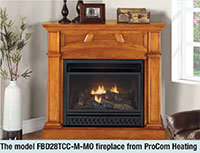
ProCom Heating Inc. (Brea, California) has a long history in the heating industry, dating back to the early 1980s. During that time, ProCom was the first Chinese manufacturer of heating products to export to the United States. Now, much of the California company’s manufacturing is transitioning to the United States.
In the early 1990s, the first U.S. corporation was started; it would become Universal Heating in Yorba Linda, California. Universal Heating was sold to Desa International in 1998, and a joint venture was created with Desa that lasted until 2001. That end was the beginning of Continental Appliances, dba ProCom, which was the company’s identity until 2012 (when ProCom Heating came to fruition).
These days, ProCom is changing from being an import company to being a U.S. manufacturing entity (in a transition that continues to this day). Patio & Hearth Products Report chatted with Kirk Kirchner, president of ProCom, about the transition, as well as the benefits of the company’s Dual Fuel technology.
What are the driving factors in moving your manufacturing to the United States?
Kirchner: The repatriation of our manufacturing is an ongoing effort that started in 2012 with our purchase of the first facility in Bowling Green, Kentucky. This facility was created to manufacture our full line of outdoor heating equipment. Since that time, we have expanded to include the facility that used to be the home of Desa International as well. All told, we have a total of 360,000 square feet of manufacturing and warehouse space, as well as an additional 68 acres of developable land in Bowling Green.
Some of the factors behind the decision to come back to the United States were the increased costs of labor and materials in China, as well as the increased costs and time on the water for ocean freight. We also looked at the seasonality of our heating business and recognized an opportunity to offer our partners the ability to level load their inventory and capitalize on fluctuations in the weather.
This decision to come back has made us the only U.S. manufacturer in the category today. Since technology has always been what has differentiated us in the industry, the expanding footprint in the United States has allowed us to focus on the development of our products, stateside, with the creation of a fully certified, CSA–accredited engineering lab for both outdoor and indoor heating products.
With the headquarters of your company being in California, why did you choose Bowling Green for your manufacturing center?
Kirchner: Besides the obvious pool of talent that existed in Bowling Green after the closure of Desa, the central location for the largest pool of heating customers made the decision fairly easy. We also understand the history of heating-products manufacturing in the town and the positive impact that it would have to the community if we brought it back to Bowling Green.
Since we opened, the community has really embraced us, and our continued expansion has firmly planted us within the fabric of Bowling Green.
Throughout this process of repatriation, what have been your biggest challenges?
Kirchner: When we began to lay out the repatriation plan with our dedicated contract manufacturer in China, it was decided that as we moved some production to the United States, it would need to consolidate its facilities in conjunction with our efforts. This consolidation took longer than it had anticipated, and in turn, that affected our ability to supply our customers in a timely manner this year.
This is also the first year of our NextGen dual gas system, our latest improvement to Dual Fuel technology. Whenever you are launching a new technology, there are always challenges. Fortunately, we are pretty good at addressing those challenges, since this is our third generation of Dual Fuel technology.
What is Dual Fuel?
Kirchner: In simple terms, Dual Fuel is the ability for a gas appliance to be installed and operated on either LP or natural gas, based on what is in the home. This is accomplished without having to make any alterations to the appliance. Our first patent for Dual Fuel was applied for in 2006, and since that time, we have been the industry leader in this technology.
Initially, our Dual Fuel technology was based on what we call our two-step design, which allows the installer to plumb the gas to either the natural-gas side or the LP side of our patented Dual Fuel regulator and then select natural gas or LP on our patented selector valve. We then evolved into a one-step design that, although patented in 2010, was never released. Our latest evolution is a no-step design that we call NextGen dual gas and have launched this season.
How is it different from the older technology?
Kirchner: Unlike our old technology, NextGen has no selector valve, and the installer merely connects the gas to the appropriate regulator inlet; no other selection is necessary. Another improvement in the technology is that with NextGen, if the installer connects the wrong gas to the wrong inlet, the unit will not be able to light, thus making NextGen the safest gas-appliance technology in the industry. We hold 24 Dual Fuel–related U.S. patents.
What are the advantages of Dual Fuel?
Kirchner: The advantages of Dual Fuel (over traditional fuel-specific appliances) are mostly in ordering, inventory management, and capital investment in inventory. If retailers do not have to worry about whether they have enough LP units versus natural-gas units, and they know that every product purchased can be sold for either application, then there is no need to carry as much inventory to make up for the split between natural gas and LP.
This means they have to dedicate less warehouse space to capturing the same amount of sales, and they have fewer dollars tied to that inventory. This is huge, when you are stocking a seasonal item. Simply put, they always have the right product on the shelf.
What is the biggest misconception about your company or products?
Kirchner: It’s that we are a Chinese company with limited industry experience. The truth is that ProCom Heating Inc. is a family-owned corporation based in the United States.
Our executive staff, today, has a combined 215 years of industry experience. Our U.S. manufacturing expansion is one of the largest single investments into manufacturing infrastructure made in our industry in the past 10 years. Our history in the industry (dating back to the early 1980s) and our commitment to the community of Bowling Green prove that our position as industry leader in vent-free technologies is well deserved.
What are your plans for the future?
Kirchner: We will continue our investment in facilities, this year, with the installation of an automated sheetmetal fabrication department to support our expanding domestic capabilities—and to feed the robotic paint line already in place. We also have plans for expanding our current markets and launching new products, with new technologies, into segments of the industry where we currently do not participate.
True to our company’s prime directive, if we enter a new category with a new product, we must bring new technology—and that is what we will do, as we expand our product offerings in the future.


