
DuraVent Offers Gas Fireplace Venting Solution
On February 25, 2020, In Industry News by Greg Thompson
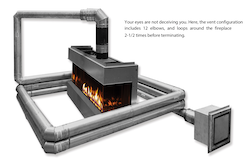
The vent configuration includes 12 elbows, and loops around the fireplace 2-1/2 times before terminating.
DuraVent’s CVS venting undergoes tests with an all new, three-sided fireplace design; one of three models being launched within Sherwood ’s Urbana Luxury Gas Fireplace brand.
A well-placed gas fireplace can literally sell a space. That is why it is so gut wrenching for an architect or owner/developer to learn that a project floorplan does not provide adequate space to discreetly vent a fireplace. All too often builders find that installing a fireplace can result in having to add unsightly bulkheads or lowering ceiling heights to hide the vent. It is a disappointment that many veterans in the building, architectural or real estate business have experienced at least once. However, a more compact venting solution from DuraVent has ignited new hope among those who want to see fewer limitations on fireplace applications.
The solution combines the installation flexibility of power venting, while reducing the required vent space. DuraVent has designed two new reducing adapters to utilize compact 3 x 5 co-axial Concentric Venting System (CVS) pipe on gas fireplaces that would otherwise be vented with DirectVent Pro 46DVA or 58DVA venting. Testing and approval of CVS before installation by the fireplace manufacturer is necessary. Some leading fireplace manufacturers are already using custom adapters in combination with DuraVent’s CVS. Additionally, specialty adapters can be developed to suit almost any OEM need, which is exciting news for anyone who understands the value and desirability that fireplaces lend to a wide variety of residential and commercial properties.
Fireplace Venting Challenges
To understand the significance of this solution, it is important to understand the limitations of traditional atmospheric and direct-vent gas fireplaces.
It’s relatively well known that traditional atmospheric fireplaces utilize B-vent that must terminate vertically through the roof. There are two fairly obvious downsides to this approach: Direct-vent fireplaces offer a bit more flexibility and efficiency, but there are still limitations. The fireplace and vent are installed as a single, sealed system. This ensures only outside air is used for combustion. Most systems utilize concentric vent pipe—with the exhaust pipe nested inside the fresh air intake pipe. The air intake (outer vent space) draws air in from outside into the firebox while combustion gases exit through the inner exhaust pipe.
CVS With Gas Fireplace
Because direct-vent fireplaces do not exhaust conditioned air to the outside, they are more efficient. They can also be side-wall vented which offers more flexibility for locating the fireplace. However, without the aid of a power vent, these fireplaces still rely on natural draft to exhaust flue gases. This means the pipe must maintain an upward slope of at least 1⁄4-inch per foot from the appliance to the outdoor termination. Depending on overall length, additional rise may be required to ensure safe vent performance which can be quite limiting when it comes to placement of the fireplace. While 1⁄4-inch per foot may seem like a small amount, it can quickly eat into the vertical space available between joists, especially given the fact that most appliances require at least three inches of clearance between the top of the vent pipe and any combustible materials above.
Power-vented fireplaces offer much more flexibility when it comes to installation location. Unlike standard direct-vent appliances, power- venting technology makes it possible to snake vent up, down, and around all sorts of structural obstacles. These fan-powered vent systems can push and pull exhaust through multiple elbows and over much longer distances. It allows a fireplace to be installed in just about any location within the structure. Power venting also provides more flexibility when it comes to locating the termination. Since there is no requirement for rise, power-vented systems can also be routed downward into floor space below and then terminated through a sidewall. However, even with power-vented systems, one problem still remains; the size of the vent pipe itself can take up precious space, especially considering that most gas fireplaces are manufactured with vent outlets that measure up to seven or eight inches in diameter.
Power Venting with CVS – Smaller and Better
The vent space dilemma has led some fireplace manufacturers to think creatively by using a specialty adapter that makes it possible to connect the appliance and inline power-vent fan or power-vented termination to DuraVent CVS 3x5 co-axial (3” exhaust / 5” intake) pipe. This smaller overall vent size allows installers to run the vent through existing joist spaces within floors and ceilings. When and if a bulkhead is needed to hide the vent, the slimmer pipe fits within a much smaller frame. This reduces the size requirement of the bulkhead, making it far less noticeable and intrusive to the space.
The key, of course, is having a readily available adapter that can easily be installed on most gas fireplaces. Custom OEM adapters have been used successfully in recent years. However, universal adapters have already been developed by DuraVent, which will be made available through a fireplace manufacturer and/or an authorized distributor. Where compatible, these adapters will fit on top of the existing twist-lock outlet on the appliance and can be installed in seconds. Depending on design, previous field conversions installing an OEM adaptor could take as long as 30 to 45 minutes to complete.
CVS With Gas Fireplace
The smaller 3 x 5 vent yields a more aesthetically pleasing application of a manufacturer’s appliances. The new adapters will make it much easier for manufacturers to adopt the smaller vent size into their installation specifications. Of course, this solution is only intended for manufacturers that offer power-vent fans and terminations, as these are not provided by DuraVent.
While the use of DuraVent’s CVS with gas fireplaces is a relatively new application, the product itself is neither new nor untested. This specific concentric venting system was originally developed by DuraVent many years ago for use with condensing gas water heaters.
The new CVS vent adapters can be made available to any fireplace manufacturers for research and testing purposes. For more information about incorporating DuraVent CVS venting and twist-lock adapters as a standard option on a specific product line, manufacturers should contact your Regional Sales Manager or DuraVent Customer Service.


